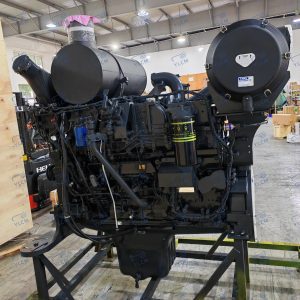
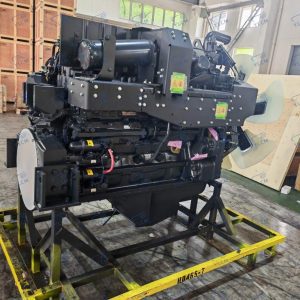
JCB excavator owners and parts managers often frame the replacement decision as a single question: OEM or aftermarket? The practical answer is that neither route is better for every component. The better choice depends on the part family, serial-number break, machine application, warranty position, and the documentation behind the supplier.
OEM and Aftermarket JCB Parts: What Each Route Means
OEM JCB parts are manufactured by or under the control of JCB and matched to a specific serial-number break. They follow the original engineering specification, packaging, and dealer distribution. That route usually provides the highest confidence on fit, but it can also carry a longer order path and a higher list price.
Aftermarket JCB parts are produced by independent manufacturers. The category includes replacement parts, OEM-equivalent parts, remanufactured units, and wear components made to the same nominal dimensions. Quality is not uniform. A well-run independent manufacturer can provide parts that match the application, while an unverified supplier can introduce tolerance, metallurgy, and heat-treatment risks. Quality management systems such as ISO 9001 help reduce process variation, but certification alone does not fully guarantee excavator-specific durability [1].
Unit price is not the same as total cost. A lower-priced part can become expensive if it fails early, increases downtime, or forces repeated labor. Use the following factors when comparing routes.
| Factor | OEM JCB Parts | Aftermarket JCB Parts |
| Fit and serial-number match | Matched to JCB engineering and serial break | Varies; must verify against serial break |
| Quality consistency | Controlled by OEM specification | Depends on supplier process controls and testing |
| Warranty | Usually backed by OEM/dealer policies | Warranty varies by supplier; confirm in writing |
| Price | Generally higher list price | Often lower initial price |
| Lead time | Stable but can be slower through dealer | Varies by stock and shipping program |
| Application fit | Strong for safety, electronic, hydraulic, and structural parts | Common for wear parts, filters, seals, pins, bushings, and undercarriage |
For safety-related components such as structural members, control valves, final drives, and hydraulic sections, a documented risk assessment and functional check are appropriate before accepting a replacement from any source [2].
Instead of selecting one route for the entire machine, itemize the replacement list.
Choose OEM or manufacturer-approved parts first for engine controls, electronic modules, hydraulic pumps, final drives, swing components, and safety-critical structural parts on machines under warranty or in high-cost operations.
Consider verified aftermarket parts for bucket teeth, cutting edges, filters, seals, pins, bushings, wear plates, track components, and older-model machines with limited OEM availability.
Compare rebuilt vs new for high-value hydraulic units only when the remanufacturer can provide test results, warranty terms, and a clear return procedure.
Check the serial-number break before ordering any route. JCB models change at serial breaks, and an otherwise correct part number may not fit a different machine version.
Aftermarket use does not automatically void equipment warranty in many markets. Under the U.S. Magnuson-Moss Warranty Act, a manufacturer generally cannot deny warranty coverage solely because a non-original part was used unless the manufacturer can show that the part caused the failure [3]. Other jurisdictions have similar consumer or commercial protections, but the buyer should keep purchase, installation, and maintenance records.
If you are comparing routes now, consolidate the request instead of running separate supplier calls. Send your JCB model, serial number, part number, required quantity, and operating conditions to [email protected]. Ask for OEM, OEM-equivalent, and aftermarket options with unit price, lead time, warranty, and documentation in one RFQ. That gives comparable numbers faster.
Sourcing Checklist for Either Route
Use the same evidence standard for OEM and aftermarket suppliers.
Confirm the exact JCB model and serial-number break before quoting.
Request part number cross-reference, dimensional drawing, material, and heat-treatment data when available.
Ask for batch traceability, inspection records, and test results for hydraulic, electrical, and structural parts.
Compare warranty terms in writing: duration, scope, exclusions, and whether labor or freight is covered.
Verify the supplier’s return, freight, and damage-handling process before payment.
Compare landed cost, including shipping, duties, and import documentation, not just unit price.
For high-value or safety-sensitive parts, run a pilot order and inspect the first article before rolling out to your fleet.
Supplier selection determines whether a lower-cost part remains a cost saving. <Choosing Reliable Excavator Parts Suppliers: A China Guide> covers audit points such as batch traceability, material documentation, testing discipline, and quote consistency.
Ready to Source JCB Excavator Parts?
Shanghai Yanli Construction Machinery Co., Ltd. was founded by Jim Hu, formerly of Komatsu China for more than 22 years, and works with more than 20 OEM and aftermarket manufacturers. Send your JCB model, serial number, part number, and required quantities to [email protected] or call +86-21-55800172. Ask for OEM, OEM-equivalent, and cost-optimized aftermarket options with lead time, warranty, and shipment terms.
FAQ
Does using aftermarket parts void my JCB warranty?
No, not automatically in many markets. The legal test often focuses on whether the part caused the failure. Keep records of part specification, installation date, and maintenance so you can defend a warranty claim if needed [3].
Are aftermarket JCB parts lower quality than OEM?
Not necessarily. Aftermarket is a broad category. Some independent manufacturers have strong material and process controls; others do not. Judge by documentation, test data, and pilot performance rather than the label alone [1].
How do I confirm the right part for my JCB excavator?
Use the machine PIN/serial number and the serial-number break rather than the model year alone. Provide the existing part number when possible, and compare photos, dimensions, and supplier cross-reference data before ordering. For safety-related systems, run a documented functional check after installation [2].
Which JCB parts are safer to buy as aftermarket?
Common candidates include bucket teeth, cutting edges, filters, seals, pins, bushings, wear plates, and certain undercarriage components. For engine controls, hydraulic pumps, final drives, electronics, and structural components, require stronger documentation and a tested supplier.
References
[1] ISO 9001:2015, Quality management systems — Requirements, International Organization for Standardization, Geneva, Switzerland, 2015.
[2] ISO 12100:2010, Safety of machinery — General principles for design — Risk assessment and risk reduction, International Organization for Standardization, Geneva, Switzerland, 2010.
[3] U.S. Federal Trade Commission, “Magnuson-Moss Warranty Act: Understanding the Federal Warranty Law,” FTC Consumer Information. [Online]. Available: https://consumer.ftc.gov/articles/businesspersons-guide-federal-warranty-law
If you’re interested, check out these related articles: