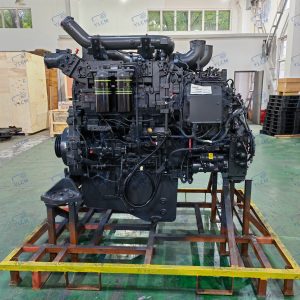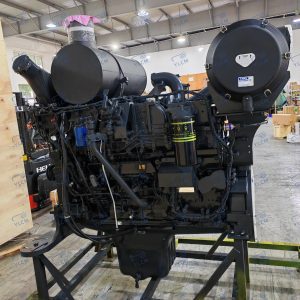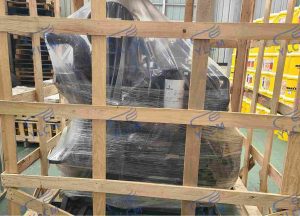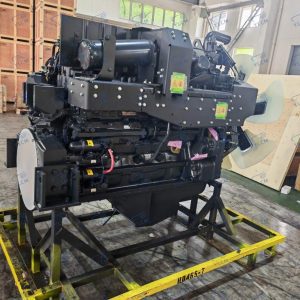

Choosing between genuine and aftermarket Doosan excavator parts starts with one question: where does this component sit in the machine’s risk profile? A bucket tooth, track shoe, or return filter can usually tolerate a different sourcing decision than a main hydraulic pump, ECU, or final drive. The right choice is not a blanket preference for one parts channel; it is a documented sourcing decision based on part number, application severity, failure consequence, available quality evidence, and total cost.
Quality documentation such as ISO 9001:2015 helps, but it is a process certificate, not a part-level guarantee [1]. Earth-moving machinery terminology is standardized to support model and serial number records [2].
Pin Down the Exact Model and Part Number First
Start from the equipment identification plate and the Doosan parts catalog, not from the machine model name alone. Doosan machine lines include model suffixes, serial number ranges, and market-specific configurations. The same nominal model can have changes in hydraulic piping, electrical connectors, engine calibration, or undercarriage pitch between production periods.
In a quote request, provide the full model designation, machine serial number or PIN, and the OEM part number from the parts catalog. If the catalog shows a superseded number, keep both numbers visible. This reduces the chance that a supplier confirms a part based on a similar-looking model rather than the exact serial break.
Where Genuine Parts Are Usually the Stronger Choice
Genuine parts are strongest where dimensional tolerance, material specification, and system interaction are critical: fuel injection, engine sensors, ECU-related components, main hydraulic pumps, main control valves, swivel joints, final drives, and safety-related items. These components are selected against the engineering release for the specific serial break and are less likely to introduce hidden compatibility risk.
In warranty discussions, the important step is to read the machine warranty text and the supplier warranty separately. Regional requirements and manufacturer policies differ. A genuine part is not a warranty waiver, and an aftermarket part does not automatically cancel the machine warranty unless the failure is traceable to that part.
Where Aftermarket Parts Can Be a Rational Choice
Aftermarket sourcing is usually more attractive for high-wear parts and consumables: bucket teeth, side cutters, cutting edges, track shoes, idlers, rollers, sprockets, pins, bushings, filters, hoses, seal kits, and some cooling and structural items. In these positions, the buyer can compare service life per hour against price and freight.
The deciding factor is not whether the part is aftermarket but whether the supplier can document material grade, hardness, dimensional control, heat treatment, and batch traceability. Unbranded aftermarket parts are not one category; they range from process-controlled and tested to visually similar but under-specified [1].
Comparison Table: Eight Factors That Decide the Parts Choice
| Factor | Genuine part | Aftermarket part | What to require |
|---|---|---|---|
| Interface risk | Released to serial break | Varies by manufacturer | OEM and cross-reference numbers |
| Material and hardness | Controlled to drawing | May vary | Mill certificate or test report |
| Traceability | Full OEM chain | Supplier dependent | Batch number and production date |
| Cost structure | Higher purchase cost | Often lower | Total cost per hour and freight |
| Lead time | Stable but sometimes long | Often shorter | Written stock confirmation |
| Warranty | Manufacturer policy | Supplier warranty | Written warranty terms |
| Critical system fit | Best for pump, ECU, final drive | Use only with strong evidence | Avoid unverified in high-risk circuits |
| Wear parts | Available | Broad and value-driven | Compare material and expected service life |
One practical filter is to separate process-controlled manufacturers from price-only trading companies. A supplier that can provide material certifications, heat treatment records, and inspection data is operating differently from one that can only quote a unit price [1].
Aftermarket quality is not a product category; it is the result of factory controls. <How Aftermarket Excavator Parts Factories Operate: A Deep Dive> covers the production and inspection steps that separate consistent parts from one-off shipments.
Build a Buying Checklist Before You Send the RFQ
Before contacting suppliers, prepare a single checklist so every quote comes back in a comparable format:
- Doosan model, serial number or PIN, and year of manufacture
- OEM part numbers from the parts catalog
- Preferred part type: genuine, aftermarket, or open option
- Target quantity and estimated annual usage
- Operating environment and attachment configuration
- Required delivery date and destination
- Required documentation: commercial invoice, packing list, material certificate, inspection report
- Incoterm and any import licensing requirement
Turn the Checklist Into a Comparable Quote
Send the completed checklist to [email protected] or call +86-21-55800172. Include the Doosan model, serial number or PIN, and the part numbers you need. Ask for the response to be broken into option lines with part number confirmation, stock status, lead time, and warranty terms rather than a single price without application details.
Supplier Verification and Import Documentation
On the trade side, confirm the HS code, country of origin, Incoterm, packaging standard, and whether the invoice needs a certificate of origin or inspection certificate. Many Doosan excavator components are classified under heading 8431.49, but the exact subheading depends on the part function and the importing country’s tariff schedule [3].
For safety-related components, require design verification and risk assessment rather than assuming that a dimensional copy is equivalent [4]. Before release, request the material grade, hardness or heat treatment records, dimensional inspection report, production batch data, surface coating, and written warranty terms. Pre-shipment inspection can be based on agreed sampling, and photographs should include part number marking, packaging, and anti-rust protection.
If the buying process is moving online, the order sequence matters. <How to Buy Doosan Excavator Parts Online: A Smart Procurement Guide> covers part number verification, documentation, and the procurement steps that reduce order errors.
Regional experience changes the supplier conversation. <Choosing Reliable Excavator Parts Suppliers: A China Guide> covers the qualification checks that help separate consistent exporters from price-only vendors.
Request a Doosan Parts Quote With the Right Details
Send the following information to [email protected] or call +86-21-55800172:
- Doosan model and serial number or PIN
- OEM part numbers or complete parts list
- Genuine, aftermarket, or open-option preference
- Target delivery date and destination
- Required documentation or inspection standard
- Estimated annual usage, if this is a repeating requirement
The more complete the part list, the fewer clarification loops you will need before receiving a comparable quote.
Frequently Asked Questions
Is genuine always better for Doosan excavators?
No. Genuine is usually stronger for high-precision and high-consequence systems such as pumps, ECUs, and final drives. Aftermarket can be a rational choice for wear parts and consumables when material and dimensional documentation is available.
What is the first information an aftermarket supplier should ask for?
The machine serial number or PIN and the OEM part number. If the supplier only asks for a model name, the compatibility risk increases.
Can aftermarket parts void my Doosan warranty?
Warranty terms vary by market. A properly supplied aftermarket part does not automatically void the entire machine warranty, but a failure caused by that part may be excluded. Review the machine warranty and the supplier warranty separately before repair.
How do I confirm an aftermarket part matches my Doosan model?
Check the serial break, part number, supersession history, installation dimensions, and supplier fitment confirmation. For critical parts, request dimensional reports and compare them with the OEM drawing or catalog notes.
What documentation should I request before paying?
Request a commercial invoice, packing list, certificate of conformity or material certificate, inspection report, warranty statement, and the correct HS code or country-of-origin documentation for your destination [3].
Is price per piece the best comparison metric?
No. Compare total cost per hour, freight, downtime risk, expected service life, and warranty support. A cheaper part with shorter life can cost more after repeated replacement and labor.
References
[1] International Organization for Standardization, ISO 9001:2015: Quality management systems — Requirements, ISO, Geneva, 2015.
[2] International Organization for Standardization, ISO 6165:2022: Earth-moving machinery — Basic types — Identification and vocabulary, ISO, Geneva, 2022.
[3] World Customs Organization, Harmonized System Nomenclature 2022, Heading 8431.49, WCO, Brussels, 2022.
[4] International Organization for Standardization, ISO 12100:2010: Safety of machinery — General principles for design — Risk assessment and risk reduction, ISO, Geneva, 2010.
If you’re interested, check out these related articles:
Sourcing Bobcat E32 Excavator Replacement Parts Without the Wait
How to Choose Excavator Undercarriage Parts for Your Machine
OEM vs Aftermarket Hitachi Undercarriage Parts: A Deep Dive
How to Replace Nissan Excavator Parts Effectively